fire pump supplier indonesia I electric , diesel and jockey pump

Fire Pump Systems for Reliable Fire Protection

PT Alat Industri Utama supplies fire pump systems for industrial facilities, commercial buildings, warehouses, power plants, factories, data centers, hospitals, and other properties requiring a dependable firefighting water supply.Our fire pump packages can be configured according to the project’s required flow rate, discharge pressure, installation conditions, control philosophy, and applicable fire protection specifications.Contact our engineering team for fire pump selection, system configuration, technical consultation, installation support, testing, maintenance, and repair services.
complete fire pump solutions


A fire pump is an essential part of a fire protection system. It increases water pressure when the available water source cannot provide the pressure or flow required by the firefighting network.

The pump normally draws water from a fire water tank, reservoir, or municipal supply and delivers it to fire hydrants, sprinkler systems, hose reels, monitors, and other firefighting equipment.

PT Alat Industri Utama provides complete fire pump solutions consisting of:

  • Electric motor-driven fire pump
  • Diesel engine-driven fire pump
  • Jockey pump
  • Fire pump controller
  • Suction and discharge manifold
  • Valves and piping accessories
  • Pressure instruments
  • Base frame and coupling guard
  • Fuel tank and diesel engine accessories
  • Testing and commissioning support

Each package can be engineered to meet the required operating duty and site conditions.

types of fire pumps

electric fire pumps

Electric motor-driven fire pump package

An electric fire pump uses an electric motor as its main driver. It is commonly selected when a reliable electrical power supply is available at the project site.

The electric fire pump package may include:

  • Centrifugal fire pump
  • Electric motor
  • Flexible coupling
  • Common base frame
  • Coupling guard
  • Fire pump controller
  • Pressure gauge
  • Isolation and check valves
  • Suction and discharge connections

Electric fire pumps offer straightforward operation, low exhaust emissions, and relatively simple routine maintenance.

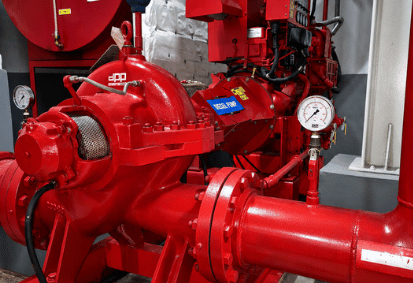
diesel fire pump

Diesel engine-driven fire pump with controller

A diesel fire pump is driven by a diesel engine and can continue operating when the main electrical power supply is unavailable.

A typical diesel fire pump package may include:

  • Centrifugal fire pump
  • Diesel engine
  • Diesel fire pump controller
  • Starting batteries
  • Battery charger
  • Fuel tank
  • Cooling system
  • Exhaust system
  • Flexible coupling
  • Base frame and coupling guard

Diesel-driven fire pumps are commonly used as the main or standby firefighting pump where independent emergency operation is required.

jockey pump

Jockey pump for fire water pressure maintenance

A jockey pump is a small-capacity pressure-maintenance pump. Its purpose is to maintain pressure in the fire water piping network and compensate for minor pressure losses or small leakage.

The jockey pump helps prevent unnecessary starting of the main electric or diesel fire pump.

A typical fire pump arrangement consists of :

1. One electric motor-driven main fire pump

2. One diesel engine-driven standby fire pump

3. One electric jockey pump


The final arrangement should follow the approved project design, hydraulic calculation, and applicable fire protection requirements.

fire pumps configurations

PT Alat Industri Utama can supply fire pumps in several configurations based on the required capacity, pressure, water source, and installation space.

end suction fire pump

An end-suction centrifugal fire pump is a compact solution suitable for many commercial and industrial fire protection applications.

Typical advantages include:

  • Compact arrangement
  • Simple piping connection
  • Accessible maintenance
  • Suitable for various capacity ranges
  • Practical installation for limited spaces

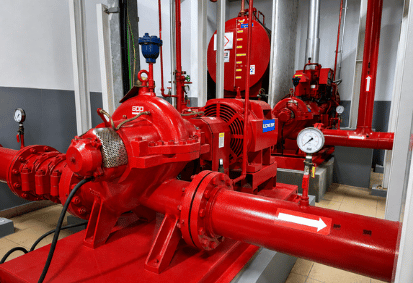
horizontal split-case fire pump

A horizontal split-case fire pump is commonly selected for high-flow fire water applications. Its casing design allows internal inspection without removing the main suction and discharge piping.

Typical advantages include:

  • High flow capability
  • Stable hydraulic performance
  • Easy access to internal components
  • Balanced pump arrangement
  • Suitable for large fire protection systems

vertical turbine fire pump

A vertical turbine fire pump is generally used when the water source is located below the pump installation level, such as an underground reservoir, deep tank, pond, or well.

Typical advantages include:

  • Suitable for below-ground water sources
  • Reduced priming concerns
  • Available with multiple bowl stages
  • Suitable for high-pressure applications
  • Compact above-ground footprint

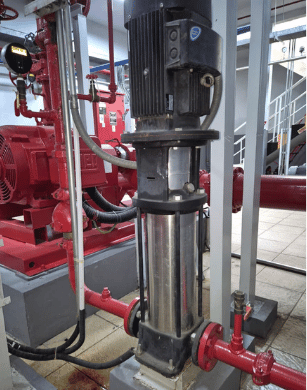
vertical in-line fire pump

A vertical in-line fire pump has suction and discharge connections arranged in line. It can be considered when installation space is limited.

Typical advantages include:

  • Small installation footprint
  • Simplified piping arrangement
  • Suitable for mechanical rooms
  • Accessible motor position
  • Practical for selected building applications

fire pump package components

A complete fire pump package can be supplied with the following equipment and accessories:

main equipment

  • Electric fire pump
  • Diesel fire pump
  • Jockey pump
  • Electric motor
  • Diesel engine
  • Common or individual base frames
  • Flexible couplings
  • Coupling guards

COntrol equipment

  • Electric fire pump controller
  • Diesel fire pump controller
  • Jockey pump controller
  • Automatic and manual operating modes
  • Local status indication
  • Alarm contacts
  • Remote monitoring interface
  • Battery charger
  • Pressure-based starting system

mechanical accessories

  • Suction isolation valve
  • Discharge isolation valve
  • Check valve
  • Pressure-relief arrangement where required
  • Pressure gauges
  • Flow meter where required
  • Test header
  • Air-release valve
  • Drain connection
  • Suction strainer where applicable
  • Expansion joint where permitted by the approved design

diesel engine accessories

  • Fuel tank
  • Fuel piping
  • Starting batteries
  • Battery rack
  • Cooling system
  • Exhaust silencer
  • Exhaust piping
  • Engine instruments
  • Speed control
  • Emergency manual starting arrangement

how A fire pump works

Under normal conditions, the jockey pump maintains pressure in the fire water network.

When a small pressure reduction occurs, the jockey pump starts automatically and restores the system pressure. Once the required pressure is reached, the jockey pump stops.

When a fire hydrant, sprinkler, hose reel, or other firefighting outlet is activated, the pressure decreases significantly. The main fire pump controller detects this pressure reduction and starts the main fire pump.

In a typical arrangement:

  1. The jockey pump starts at the first pressure set point.
  2. The electric fire pump starts when pressure falls below the main pump set point.
  3. The diesel fire pump starts if pressure continues to fall or if the electric pump is unavailable.
  4. The operating fire pump supplies water to the firefighting network.
  5. Pump status and alarms are displayed at the controller and can be transmitted to a monitoring system.

The final starting sequence and pressure settings must be determined during engineering and commissioning.

reccomended internal links